
An Evening to Remember
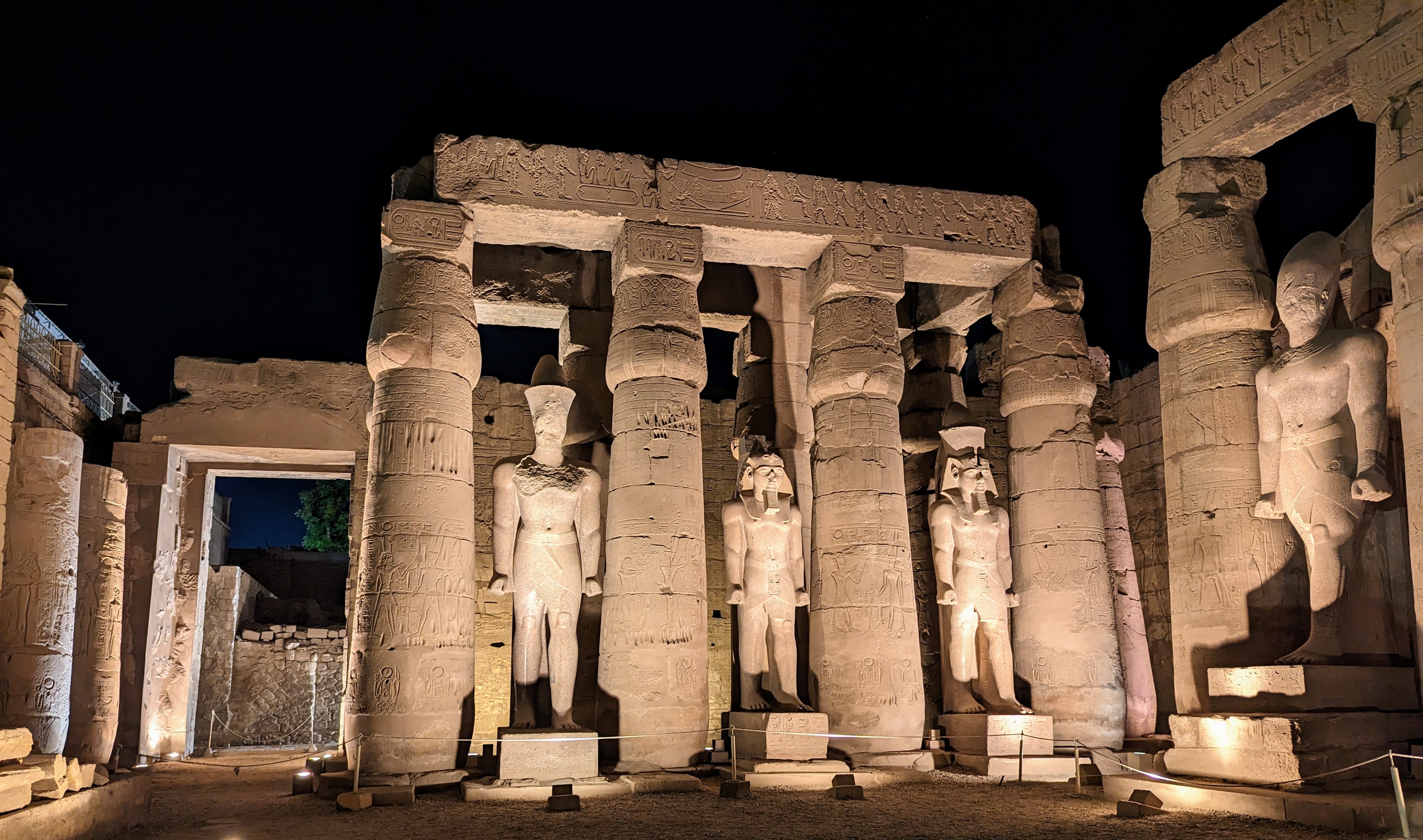
Following a memorable dinner beside the Nile, we made our way to the magnificent Temple of Luxor, located on the east bank of the river in modern-day Luxor, the site of ancient Thebes. As darkness settled over the city, the temple's illuminated columns, statues, and towering walls created a dramatic first impression. Walking along the avenue flanked by colossal figures of Ramesses II, it was easy to imagine the awe that ancient Egyptians must have felt when approaching this sacred place more than three thousand years ago.Construction of the temple began around 1400 BCE during Egypt's New Kingdom and was expanded by several pharaohs, including Amenhotep III and Ramesses II. Unlike many Egyptian temples dedicated primarily to a deity, Luxor Temple played an important role in royal ceremonies and the annual Opet Festival, during which sacred processions travelled between Karnak and Luxor. Over the centuries, the site witnessed successive layers of Egyptian, Greek, Roman, Christian, and Islamic history. During the Roman period, the temple complex was incorporated into a military fortress, leaving visible traces that can still be seen today. These overlapping civilizations make Luxor Temple not only a remarkable monument of ancient Egypt but also a testament to the thousands of years of continuous human activity along the Nile.
This evening visit offered a unique perspective, as the temple's sandstone structures glowed warmly beneath the floodlights, bringing its ancient grandeur vividly to life against the night sky.
 |
| Ramses II, 2023 Geoffrey W. Sutton | suttong.com |
 |
| Tutankhamun & wife Ankhesenamun 2023, Geoffrey W. Sutton | suttong.com |
 |
| Making an Offering suttong.com |
 |
| Ramses II, Luxor Temple, 2023 Geoffrey W. Sutton | suttong.com |
The Avenue of the Sphinxes - Luxor Temple

The Courtyard of Ramses II
Temple Information
Although several pharaohs left their mark on Luxor Temple, Ramesses II was its most significant contributor. His additions include the monumental entrance, colossal statues, and towering obelisk that continue to define the temple's appearance today. Other rulers who contributed to the complex over the centuries include Tutankhamun, Horemheb, Seti I, Merenptah, Ramses III, Ramses IV, Ramses VI, and Alexander the Great, each adding chapels, reliefs, inscriptions, or restoration work.
The temple was dedicated to the Theban Triad: Amun, king of the gods; his consort Mut; and their son Khonsu, the moon god. It played a central role in the annual Opet Festival, one of ancient Egypt's most important religious celebrations.
For centuries, much of Luxor Temple lay buried beneath sand and the expanding city. Modern excavation of the site began in 1884, gradually revealing one of the best-preserved temple complexes in Egypt and providing archaeologists with valuable insights into more than three millennia of Egyptian history.
The Rulers
Story boards near the entrance offer basic information on the ruler who contributed to the temple complex. Here are those images (all dates are BCE).
Hatshepsut (1473-1458 BCE)
One of ancient Egypt's most successful female pharaohs, Hatshepsut expanded trade networks and commissioned impressive building projects throughout Egypt. Her reign marked a period of stability and prosperity during the early New Kingdom. |
Amenhotep III (1390-1353 BCE)
Amenhotep III initiated the construction of Luxor Temple during one of Egypt's most prosperous eras. Under his rule, Egypt reached the height of its political power, wealth, and artistic achievement.
Tutankhamun (1332-1323 BCE)
Although famous today for the discovery of his nearly intact tomb, Tutankhamun also contributed to the decoration of Luxor Temple. He restored traditional religious practices after the upheaval of his predecessor's reign.
Ramesses II (1279-1213 BCE)
Often called "Ramesses the Great," he transformed Luxor Temple through monumental additions, including colossal statues, an obelisk, and the grand entrance pylon. His long reign made him one of Egypt's most celebrated and influential pharaohs.
Pinedjem I (1070-1032 BCE)
A high priest of Amun who later assumed royal authority in Upper Egypt, Pinedjem I helped preserve Egypt's religious traditions during a politically fragmented period. His rule reflects the growing power of the priesthood at Thebes.
Nectanebo I (379-361 BCE)
Founder of Egypt's 30th Dynasty, Nectanebo I was among the last native Egyptian pharaohs before foreign conquest. He sponsored major construction projects, including the avenue of sphinxes that linked Luxor Temple with Karnak Temple.
Our Day Ends
We boarded our coach for the long journey back to the cruise ship.
Link to Egyptian sites
Please check out my webpage to see if any of my books on psychology topics might be of interest.
Geoffrey W. Sutton suttong.com
Comments
Post a Comment